
Parabolas
Conic Sections
Conic Sections
Now that we have seen the standard conic form of a parabola having a vertex at the origin, we next want to consider how we can work with a parabola that is not located at the origin. Recall that a function with a horizontal shift will have the general factor expression \((x-h)\). So for example, the expression \((x-3)\) represents a shift of 3 units in the positive \(x\)-direction while the expression \((x+1)\) is a shift of 1 unit in the negative \(x\)-direction. We can apply the same idea to vertical shifts, \((y-k)\). So, \((y-2)\) is a vertical shift of 2 units in the positive \(y\)-direction while \((y+5)\) is a vertical shift of 5 units in the negative \(y\)-direction. Let's look at the standard formula, the key characteristics, and then a few examples of shifted parabolas.
The standard conic equations of a parabola with vertex at the point \((h,k)\) have the following form.
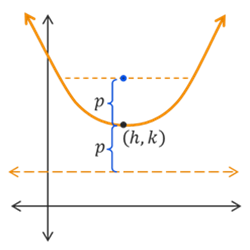 \[(x-h)^2 = 4p(y-k)\]
The focus is located at the point \((h,p+k)\) and the directrix is the horizontal line \(y = -p+k\). The parabola will open up if \(p > 0\) or down if \(p < 0\). The focal diameter length is \(|4p|\).
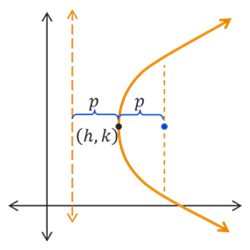 \[(y-k)^2 = 4p(x-h)\]
The focus is located at the point \((p+h,k)\) and the directrix is the vertical line \(x = -p+h\). The parabola will open right if \(p > 0\) or left if \(p < 0\). The focal diameter length is \(|4p|\).
When dealing with shifted parabolas, the overall shape and distances remain the same. That means that \(p\) still gives us the distance from the vertex to the focus and the distance from the vertex to the directrix. The parabola still curves around the focus and away from the directrix. The length of the focal diameter is still \(|4p|\). The only thing that has changed is that the location of everything has been shifted horizontally by \(h\) and vertically by \(k\).
Let's look at some examples of parabolas that have been shifted away from the origin.
©2025 M4thG33x (new window) Some Rights Reserved.
