
Ellipses
Conic Sections
Conic Sections
Just like we did with parabolas, we now want to consider ellipses that are not centered at the origin. Remember that equations representing functions shifted horizontally a distance of \(h\) units will contain the expression \((x-h)\) while equations respresenting a vertical shift a distance of \(k\) units will contain \((y-k)\). Let's look at the standard formula, the key characteristics, and then a few examples of shifted ellipses.
The standard conic equations of an ellipse with center at the point \((h,k)\) have the following form.
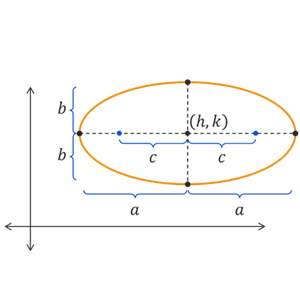 \[\frac{(x-h)^2}{a^2} + \frac{(y-k)^2}{b^2} = 1\]
Assuming that \(a > b > 0\), the vertices are at \((h \pm a,k)\) while the co-vertices are located at \((h,k \pm b)\). The foci are located at \((h \pm c,k)\). The major axis has a length of \(2a\) and the minor axis has a length of is \(2b\). The distance between the foci is \(2c\).
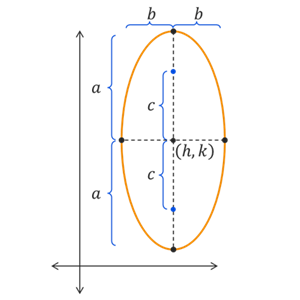 \[\frac{(x-h)^2}{b^2} + \frac{(y-k)^2}{a^2} = 1\]
Assuming that \(a > b > 0\), the vertices are at \((h,k \pm a)\) while the co-vertices are located at \((h \pm b,k)\). The foci are located at \((h,k \pm c)\). The major axis has a length of \(2a\) and the minor axis has a length of is \(2b\). The distance between the foci is \(2c\).
When dealing with shifted ellipses, the overall shape and distances remain the same. That means that the values of \(a\), \(b\), and \(c\) still represent the longest radius from the center to each vertex, the shortest radius from the center to each co-vertex, and the distance from the center to each focus point, respectively. The larger denominator still determines the orientation of the ellipse, we still have the equation \(c^2 = a^2 - b^2\), and the eccentricity is still \(e = \frac{c}{a}\).
Let's look at some examples of ellipses that have been shifted away from the origin.
©2025 M4thG33x (new window) Some Rights Reserved.
