
Hyperbolas
Conic Sections
Conic Sections
The general equation of a conic section is given below, where \(A, B, ..., F\) are Real numbers.
\[Ax^2 + Bxy + Cy^2 + Dx + Ey + F = 0\]However, the \(Bxy\) term can result in conics that are skewed or oriented in directions other than horizontal or vertical which is beyond the scope of this course, so we will focus on conics equations where \(B = 0\). This simplifies the above equation to the following.
We refer to the equation below as the general conic equation because this one equation is able to express all four primary conic sections (parabolas, circles, ellipses, and hyperbolas) as well as all degenerate conic sections (line, pair of intersecting lines, or single point).
\[Ax^2 + Cy^2 + Dx + Ey + F = 0\]For a given conic equation in general form that is a non-degenerate conic, and assuming that both \(A \ne 0\) and \(C \ne 0\), we can easily determine which primary conic section is represented by the given equation using the following.
Once we identify which conic section is represented by a given general equation, we can rewrite the general equation in the corresponding standard equation form by completing the square.
Here are a few examples of conics given in general form and their cooresponding standard form.
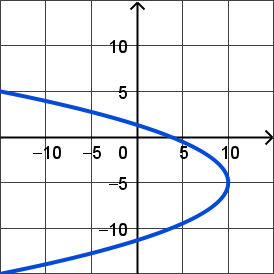
The equation represents a parabola because \(A=0\), meaning the \(x^2\) term is missing.
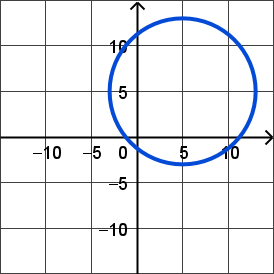
The equation represents a circle because \(A=C\), since \(A=1\) and \(C=1\).
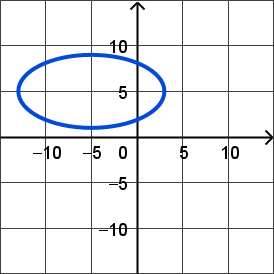
The equation represents an ellipse because \(A\) and \(C\) have the same signs but are not equal, since \(A=1\) and \(C=4\).
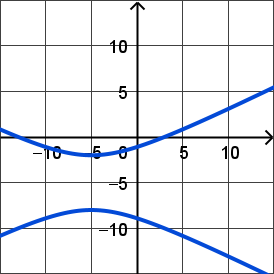
The equation represents a hyperbola because \(A\) and \(C\) have opposite signs, since \(A=-9\) and \(C=36\).
©2025 M4thG33x (new window) Some Rights Reserved.
